News & Updates
Direct Air Capture & Net Zero Aviation: An Update

As the global aviation industry works towards net zero, important developments, progress and commitments are happening at a rapid pace. It can be challenging to keep up with all the key news, so Carbon Engineering has compiled some of the most relevant information from this month.
A variety of factors make aviation complicated to decarbonize, including the need for high energy density fuels, high demand growth, and the inherent long-haul nature of many flights. In spite of these challenges, the industry is quickly accelerating efforts to become more sustainable and reach critical net zero goals. As evidence of this progress, Carbon Engineering is already seeing commitments from the aviation industry to integrate our Direct Air Capture solutions into their sustainability portfolios. Our technology is key for two pathways to aviation decarbonization: permanent carbon dioxide removal and the production of sustainable aviation fuels.
July has seen several key developments in the aviation industry’s path to net zero. These include:
- An expert report on how aviation can reach net zero emissions.
- A significant announcement from aviation industry leaders on an intent to explore carbon removal solutions for aviation, following a large carbon removal purchase from Airbus in March.
- A report outlining the UK’s strategy for net zero aviation by 2050
- An important international aviation industry meeting on setting a goal for emissions reductions
- The first general assembly of the renewable and low carbon fuels alliance in the Europe Union
Read below for a summary of these developments – all powerful indicators of the progress the aviation industry is making towards a net zero future.
1. New Expert Report Recognizes the Importance of Direct Air Capture in Aviation Decarbonization
A new report, Making Net-Zero Aviation Possible: An Industry-Backed, 1.5°C Aligned Transition Strategy, outlines scenarios for how the sector can reach net zero emissions by 2050. The report, released on July 14, is backed by more than 60 industry leaders, the Mission Possible Partnership, and the World Economic Forum-led Clean Skies for Tomorrow Coalition.
This significant report provides a net zero roadmap to get the aviation industry on track to deliver on a 1.5°C target. It advocates for immediate action and sets specific and deadline-driven milestones to achieve this goal. As an industry-led report, the insight and direction comes directly from those driving the sector’s transition, adding further credibility and increasing the strategy’s potential for long-term success. Carbon Engineering is pleased to see the inclusion of Direct Air Capture in the report’s net zero scenarios – a signal of the growing consensus that carbon dioxide removal and Direct Air Capture are expected to play a key role in the decarbonization of aviation. Below are our main takeaways from the report:
Direct Air Capture is highlighted as a key solution for decarbonizing aviation through both carbon dioxide removal and power-to-liquids sustainable aviation fuels.
Direct Air Capture can support aviation decarbonization in two important ways. Firstly, carbon dioxide captured from the atmosphere through Direct Air Capture can be used to produce power-to-liquids sustainable aviation fuels. Power-to-liquids fuels are synthetically produced hydrocarbons, made using renewable electricity, water and carbon dioxide. When produced through Carbon Engineering’s AIR TO FUELSTM process, these fuels are near carbon neutral and can work in existing planes without any modifications.
Secondly, atmospheric carbon dioxide captured from Direct Air Capture can be safely stored underground to deliver permanent and measurable carbon dioxide removal. Carbon removal activities complement emissions reductions solutions, like sustainable aviation fuel, by providing a tool to address any remaining emissions that cannot be directly eliminated. The report separately defines both carbon dioxide removal and power-to-liquids sustainable aviation fuel from carbon dioxide as necessary for net zero.
Sustainable aviation fuel produced from atmospheric carbon dioxide through Direct Air Capture is expected to play a significant role in the future of aviation.
The report highlights atmospheric carbon dioxide from Direct Air Capture as the long-term feedstock for power-to-liquids sustainable aviation fuel, citing 490 to 730 megatonnes per year needed as feedstock by 2050. This shows potential for substantial market demand from the aviation sector for sustainable aviation fuel produced using Carbon Engineering’s technologies.
The scenarios in this report recognize carbon dioxide removal as necessary for aviation to reach net zero by 2050, and calls for removals and investment to begin now.
Notably, the report highlights a minimum of 120-140 megatonnes per year of removals by 2050 to counterbalance residual aviation emissions. The report calls for removals as a necessary part of the pathway to reach net zero, and for investment to start immediately. This is well aligned with Carbon Engineering and 1PointFive’s global deployment approach, which supports 1PointFive’s scenario of 70 Direct Air Capture facilities online by 2035.
Read the full report here.
2. Airbus and Major Airlines Explore Carbon Removal Credits from Direct Air Capture Technology
Earlier this year, Carbon Engineering’s global deployment partner, 1PointFive, announced a significant sale of 400,000 tonnes of carbon removal credits to aerospace leader Airbus. Under the agreement, Airbus pre-purchased the capture and permanent sequestration of 100,000 tonnes of carbon dioxide from the atmosphere each year for four years, to be delivered from 1PointFive’s planned first Direct Air Capture facility using Carbon Engineering’s technology.
Building on this news, on July 18 at the Farnborough Air Show, Airbus and a number of major airlines announced they have signed Letters of Intent to explore opportunities for a future supply of carbon removal credits from Direct Air Capture. The airlines – Air Canada, Air France-KLM, easyJet, International Airlines Group, LATAM Airlines Group, Lufthansa Group and Virgin Atlantic – have committed to engage in negotiations on the possible pre-purchase of verified and durable carbon removal credits starting in 2025 through to 2028. The carbon removal credits will be issued by 1PointFive.
This announcement reinforces important elements from the Mission Possible Partnership report—carbon dioxide removals are essential to counterbalance residual emissions, and investment must start today. The commitment by Airbus and these airlines to explore carbon removal demonstrates these key, industry-led recommendations playing out through real-world action, from some of aviation’s leading organizations. This announcement is a great example of concrete steps the aviation sector is taking today on the pathway to reaching net zero.
Read the full press release here.
3. The UK Releases a Strategy for Net Zero Aviation by 2050
On July 19 at the Farnborough Airshow, the UK’s Department of Transport released their Jet Zero Strategy – a framework and plan for delivering net zero aviation for the UK by 2050.
The Jet Zero Strategy has some highly relevant contents related to Direct Air Capture and sustainable aviation fuel, including:
- The UK sustainable aviation fuel (SAF) mandate will start in 2025, requiring the UK’s jet fuel mix to include at least 10% SAF by 2030.
- The strategy states that a UK SAF industry could generate substantial economic benefits, with up to £2.7bn gross value added for the UK from UK production and global exports. By 2035, a domestic industry is expected to support 5,200 jobs.
- The strategy also includes a £165m Advanced Fuels Fund to support first-of-a-kind commercial and demonstration plants. Funding will be available for three years and will build on the progress made in previous advanced fuels grant competitions, like Green Fuels Green Skies, which Carbon Engineering participated in.
- Included in the Jet Zero Strategy is a case study on Carbon Engineering, our Direct Air Capture technology and AIR TO FUELSTM process, and the role both can play in aviation decarbonization. The case study also cites Carbon Engineering and 1PointFive’s global deployment of Direct Air Capture, including engineering for a large-scale facility targeted for northeast Scotland.
Carbon Engineering is honoured to have been named a member of the UK Jet Zero Council. As a member, we will lend our insight and expertise as leaders in Direct Air Capture to support the advancement of policies for UK aviation decarbonization.
Read the full report here.
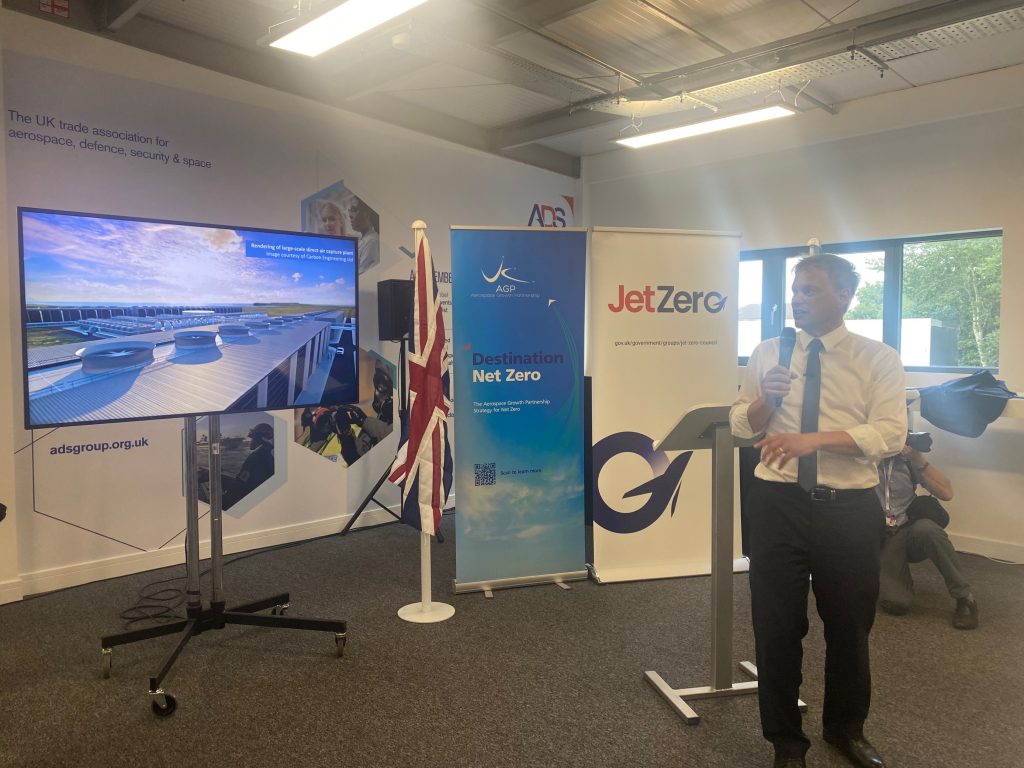
Grant Shapps, UK Secretary of State for Transport, speaking on the Jet Zero Strategy at the Farnborough
Air Show. Shown at left on screen is a rendering of a large-scale facility using CE’s DAC technology.
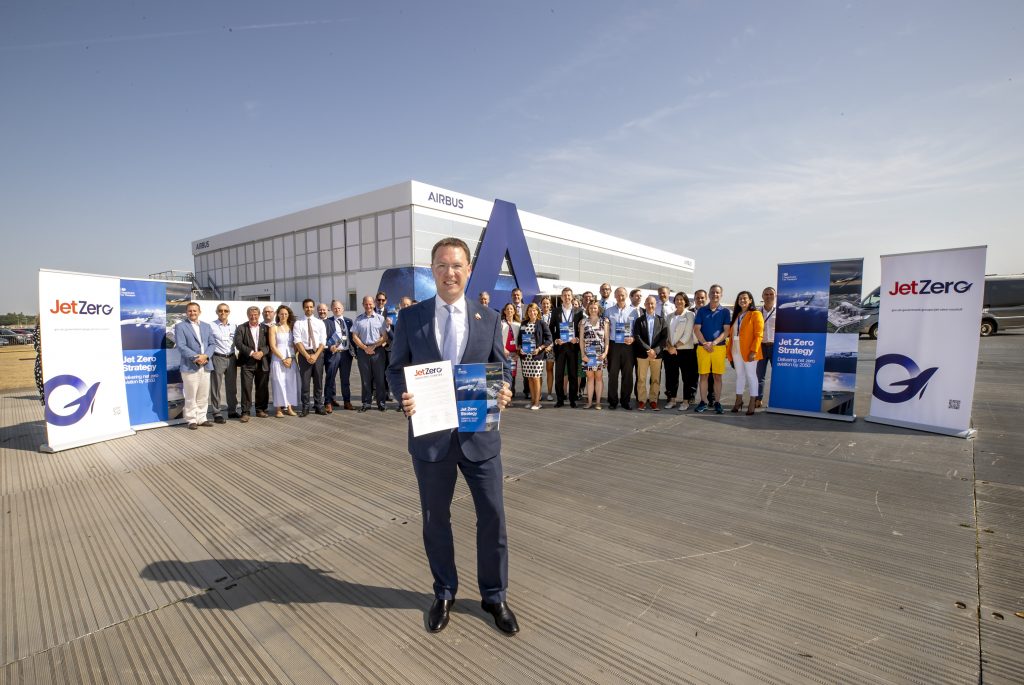
Robert Courts, UK Minister for Aviation & Maritime, foreground, and members of the Jet Zero Council at the
Farnborough Air Show, including CE’s VP Europe, Amy Ruddock. Credit: UK Department of Transport.
4. An Important United Nations Aviation Industry Meeting on Emissions Reductions
In Canada, Carbon Engineering was in attendance last week at a significant aviation industry meeting. The International Civil Aviation Organization (ICAO) held their high-level meeting on the feasibility of a long-term aspirational goal for international aviation carbon dioxide emissions reductions. The ICAO is an aviation-focused agency of the United Nations, funded and directed by 193 national governments and headquartered in Montreal.
The meeting brought together decision makers and participants from member countries to discuss carbon dioxide emissions reduction scenarios. Attendees focused on options for an emissions reductions goal, implementation, recommendations, and how goal progress will be monitored. This is a key milestone in the run up to the ICAO triennial meetings this coming September, where ICAO is attempting to adopt their long-term aspirational goal for aviation for 2050.
Alongside these meetings, ICAO hosted an exhibition, providing an opportunity for attending countries to showcase their innovations towards addressing aviation sector emissions. As a member of the Canadian Council for Sustainable Aviation (C-SAF), Carbon Engineering was pleased to be part of the exhibition highlighting how the Canadian ecosystem is responding to the challenge of aviation decarbonization. This was a great opportunity for Carbon Engineering to engage with delegates from around the world, and highlight our technology and the role it can play in helping a hard-to-abate sector decarbonize globally.
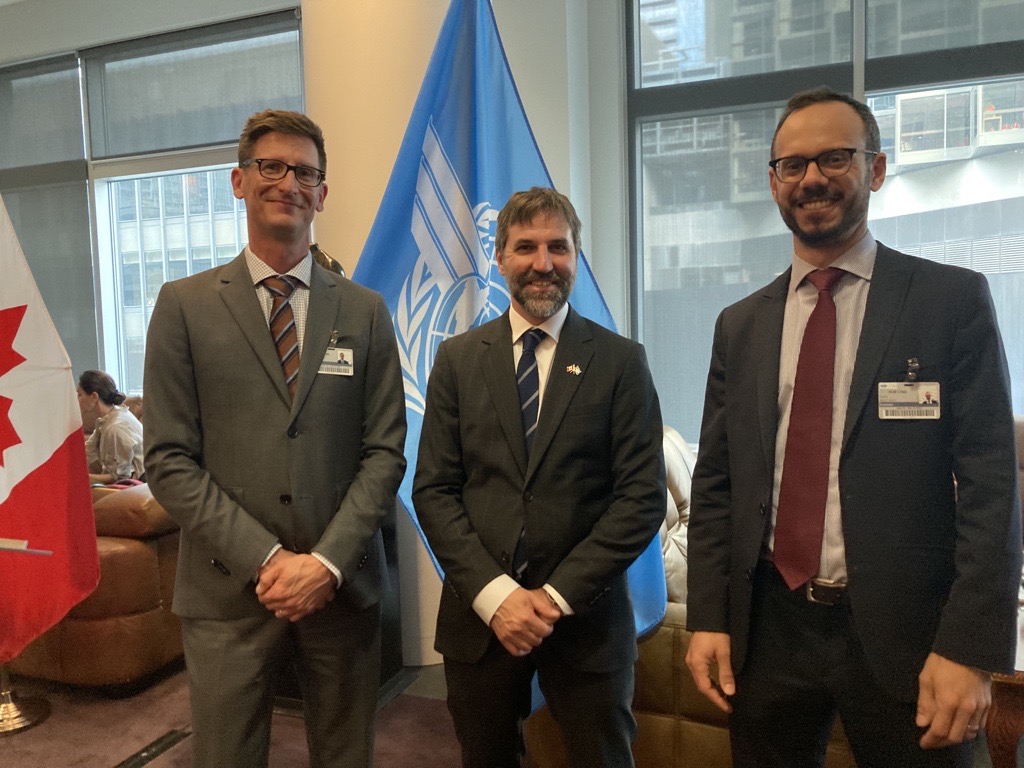
Geoffrey Tauvette, Executive Director, C-SAF, left, The Honourable Steven Guilbeault,
Minister of Environment and Climate Change of Canada, centre, and Adam Baylin-Stern, Policy and
Engagement Lead, Carbon Engineering, right. Pictured at the ICAO high-level meeting in Montreal.
Credit: Office of the Minister of Environment and Climate Change.
5. First General Assembly of the EU Renewable and Low Carbon Fuels Alliance
Carbon Engineering attended the first General Assembly of the European Union (EU) Renewable and Low-Carbon Fuels (RLCF) Value Chain Industrial Alliance July 12. The Alliance was launched in April 2021 by Transport Commissioner Adina Vălean, with the support of key industrial partners and trade associations. The intention is to boost supply and support demand of renewable and low-carbon fuels in Europe in line with the EU climate ambition by 2050. Both aviation and maritime sectors are in focus.
There are five objectives:
- Identify pathways
- Assessment of enabling conditions, including needed policy measures
- Map available funding
- Launch a business investment platform and determine a credible pipeline of projects
- Build synergies across all transport modes and other alliances.
Carbon Engineering is pleased to be part of the RLCF alliance and looks forward to developing new partnerships to deliver near carbon-neutral fuels through Direct Air Capture for this important market.

Head Office & Mailing Address:
PO Box 187, 37322 Galbraith Road, Squamish, B.C.,
V8B 0A2
Suite 430, 609 Granville Street, Vancouver, B.C., V7Y 1G6
CARBON ENGINEERINGTM, the CE design, A2FTM, and AIR TO FUELSTM are trademarks of Carbon Engineering ULC.
Carbon Engineering ULC., Copyright 2026. Privacy Policy